For over a year after Donald Trump re-entered the White House, Ukraine publicly maintained a hopeful stance, aiming to secure his support. Trump, consistently demonstrating his admiration for Russia’s Vladimir Putin, significantly ceased U.S. military assistance to Kyiv. He frequently disparaged Ukrainian officials, even personally rebuking President Volodymyr Zelensky during an Oval Office meeting in February 2025. Despite this, Ukraine actively engaged in Trump’s peace talks, which favored Putin’s aggression and ultimately proved unproductive. Zelensky consented to mineral agreements purportedly designed to benefit Americans. He even extravagantly commended Trump himself. Although Ukrainian leaders harbored increasing reservations, they believed that speaking favorably about the American president could only help, and might even win his good graces.
However, Kyiv now seems to have lost faith in the United States. It is actively pursuing alternative diplomatic and military alliances—for example, by sharing its valuable drone warfare knowledge with Saudi Arabia, Qatar, and the United Arab Emirates, and establishing arms manufacturing deals with Germany. Ukraine has deployed drones to target oil export terminals near St. Petersburg, far into hostile territory, disregarding what Zelensky referred to as “indications” from unnamed “partners” against hitting Russian energy assets.
In a striking shift, employing rhetoric previously considered unimaginable, Zelensky has signaled his belief that the United States is no longer a dependable ally, and, even more remarkably, that Europe as a whole must begin to pivot away from its transatlantic ties.
To prevent further surges in energy costs during the U.S.-Israeli conflict with Iran, the Trump administration relaxed restrictions on Russian oil producers and vendors. Last week, during an interview with Italian radio, Zelensky denounced this action. He stated, “I believe Russia outmaneuvered the Americans once more—it outmaneuvered the president of the United States.” (The waiver on sanctions concluded earlier this week.) To ensure his message reached a wider audience beyond Italy, Zelensky shared an English translation of his remarks on X.
Soon after, Zelensky contended that if the U.S. indeed intends to pull out of NATO, as Trump has indicated, then European democracies require an entirely new defense framework. He proposed that, to protect itself from Russia without American aid, the European Union would need to integrate the defense capacities of non-member states like Norway, the United Kingdom, Turkey, and Ukraine.
He thereby highlighted a stark divergence from other European leaders who, over the preceding 15 months, had unconvincingly maintained the illusion of continued U.S. dedication to its long-standing allies. In doing so, some leaders compromised their dignity, exemplified by NATO Secretary General Mark Rutte’s reference to Trump as “Daddy.” (Rutte, a Dutchman, later clarified the remark as a “language issue.”) Acknowledging that Trump’s reascension had rendered the U.S. a danger to European security was something no one wished to confront.
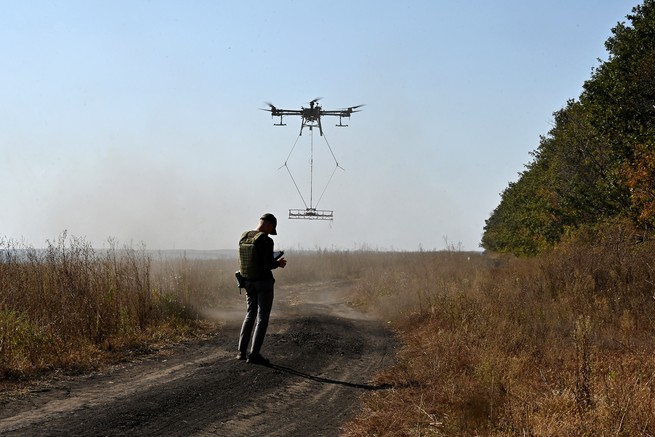
An operator in Ukraine deploys an unmanned aerial vehicle fitted with a metal detector for mine detection operations in the Kharkiv area.
Several elements contribute to Ukraine’s newfound candor. The U.S. has scaled back the limited armaments it was supplying to Ukraine, prioritizing its own reserves for the conflict with Iran. While Trump has, at times, mentioned imposing severe sanctions on Russia—possibly to satisfy pro-Ukraine factions within his party—he has recently refrained from such actions. Most disheartening for Ukrainians, the Trump administration has repeatedly urged them to relinquish their land and citizens in the Donbas to Putin as part of a peace agreement.
These events have compelled Zelensky and his colleagues to openly address America’s increasing proximity to Putin and to alert other European nations to the impending risks.
Ukraine’s revised public stance coincides with an improvement in its military circumstances, particularly compared to its difficulties last year. Heavily depending on their domestic drone production and military framework, Ukrainian forces have recaptured momentum in numerous sectors. Over recent months, they have reportedly inflicted more losses than Russia can replenish—and have recovered more land than Russia had captured. On the front lines, Ukraine has reinforced and expanded its “drone wall,” limiting the mobility of Russian ground troops. Earlier this week, Kyiv asserted that it had taken a Russian stronghold and detained several Russian soldiers without any Ukrainian personnel being exposed, relying solely on unmanned aerial and ground vehicles.
Concurrently, Ukrainians have become more adept and confident in executing drone attacks on medium and long-range objectives deep behind enemy lines, as demonstrated by the strike near St. Petersburg. Furthermore, Ukraine persists in confining Russian naval capabilities within the Black Sea. Even ships in Russia’s most fortified naval bases are no longer immune to Ukrainian assaults.
Over the last 15 months, American officials and numerous Western experts have predominantly focused on Ukraine’s vulnerabilities. Trump notably declared last year that Ukrainians possessed “no cards” to play. Yet, their capacity to adjust, even without U.S. assistance, has been remarkable. Currently a world leader in drone innovation and production, Ukraine is reportedly projecting the manufacture of as many as 7 million military unmanned aerial vehicles by 2026.
Ukrainians would strongly prefer the United States to align with them rather than with Russia. Between 2022 and 2024, Washington supplied more military assistance to Ukraine than any other nation. While much of this aid was disbursed gradually, and sometimes came with frustrating restrictions, it was vital for Ukraine’s survival during the initial years of the conflict. Nevertheless, Ukrainians are not convinced that the loss of American backing will automatically result in their downfall. They observe their ability to maintain the war effort through their own means and with support from European allies, even as the U.S. has distanced itself. Dismissing the United States as an ally might once have portended disaster for Ukraine. That is no longer the case.