The consensus among those I spoke with at GDC was overwhelmingly focused on Crimson Desert, a title now dominating sales across all available platforms. Such performance metrics typically signal significant success. Crimson Desert has long been a game we’ve monitored, consistently appearing high on our weekly wishlist rankings, but the excitement surrounding it has now reached unprecedented levels.
Crafted over seven years by Pearl Abyss, the developers behind the MMO hit Black Desert, Crimson Desert has transformed from an MMO prequel into a sprawling, independent open-world action game. It’s scheduled for release on PC, PS5, and Xbox on March 17, priced at $70.
Taking place on the war-ravaged continent of Pywel (a rather fitting, Welsh-sounding name😎), Crimson Desert‘s gameplay combines high-fidelity combat with intricate environmental interactions. Players are offered a wealth of choices, and the potential for discovery is immense.
One moment, you might be soaring through the skies on a dragon’s back; the next, you’re engaged in fishing, or even piloting a mech. It’s an incredibly expansive game, introducing mechanics to the player at a rapid pace.
Movement throughout the world is remarkably fluid, and the game’s proprietary engine allows for an astonishing variety of approaches to challenges. It undeniably draws significant inspiration from Breath of the Wild.
The anticipation is palpable, so if Pearl Abyss manages a successful launch, we could be looking at the first major new IP of 2026.
With its launch date rapidly approaching, player interest is already translating into substantial early sales. As of yesterday, Crimson Desert was nearing 400,000 pre-launch units sold on Steam, generating gross revenues exceeding $20 million.
Remarkably, over 10% of these sales occurred within a single 24-hour period yesterday, contributing $2.6 million in revenue as the marketing campaign reached its peak. This game has the potential to truly explode if its execution lives up to expectations.
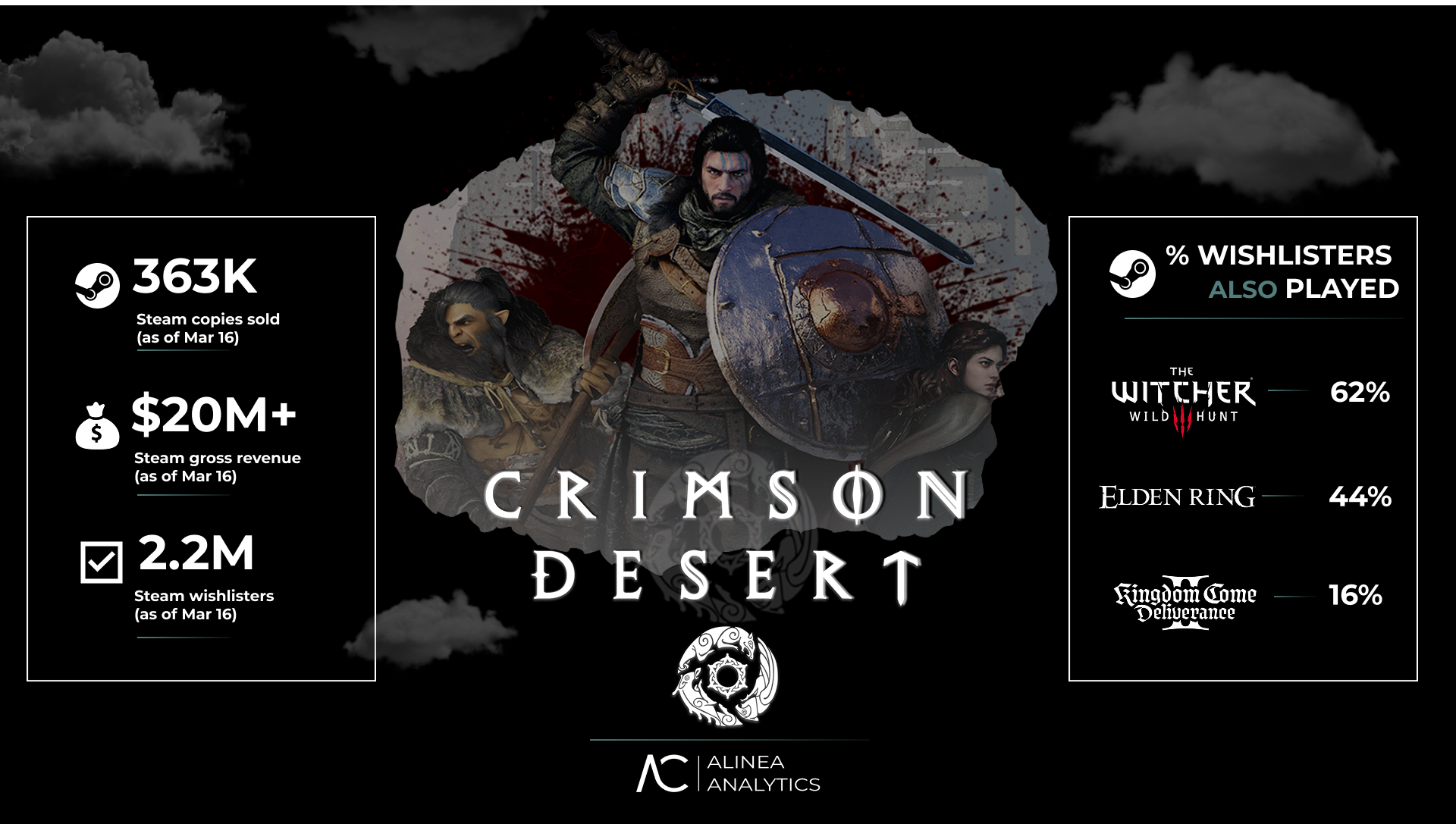
Players are demonstrating considerable interest. Pearl Abyss reported that Crimson Desert garnered 3 million wishlists last week, with our estimations suggesting approximately 2.2 million of these originating from Steam. It’s worth noting that for a successful $70 AAA game, the conversion rate from wishlist to buyer is typically quite modest, around 6-7% in the week following launch.
As illustrated in the Alinea Analytics platform screenshot (secure your free trial!) provided below, Crimson Desert has amassed over 1 million new Steam wishlists since early February, with an impressive 680,000 added just this month:
Anticipation truly began to build in recent months, fueled by extensive community engagement and strategic announcements. Overall, the marketing efforts—including the gameplay reveal and the recent deep dives into features—have been exceptional.
However, where Pearl Abyss has truly excelled is in effectively managing online sentiment, actively listening to community feedback, and responding with solutions that resonate with gamers.
Their approach feels genuine. PR and Marketing Director Will Powers has been key to this strategy, adopting an unusually candid communication style. Frankly, it’s a breath of fresh air amidst the typical PR rhetoric we often encounter. Authenticity, it seems, is winning.
Here are a few notable examples that have particularly stood out:
-
Clarity on genre and expectation management: To prevent misunderstandings, the developers have consistently clarified that Crimson Desert is an action-adventure title, not a traditional RPG. They have also explicitly avoided overhyping the game, promoting a realistic view. By stating that Crimson lacks features such as character creators, branching dialogue, or conventional leveling systems, they are proactively setting expectations to avert a situation akin to the Cyberpunk launch.
-
Detailed specifications with excellent optimization: On March 10, Pearl Abyss published the PC and console specifications, addressing earlier concerns about the game’s performance on consoles and mid-range systems. It appears highly optimized, even capable of running on 10-year-old 1060 GPUs.
-
Showcasing console footage: On March 12, following ongoing community requests for console gameplay, the team granted Digital Foundry unrestricted access to demonstrate the game running on PS5 Pro. DF’s enthusiastic preview helped placate skeptics. Further, Pearl Abyss collaborated with PlayStation Japan to exhibit the base PS5 version.
-
No microtransactions at launch: Given Pearl Abyss’ background in MMOs, many players were apprehensive about Crimson Desert’s monetization strategy. During the Dropped Frames podcast on March 12, Pearl Abyss marketing director Will Powers stated, “I can definitively say: there is no cosmetic cash shop. This is designed as a premium experience that you purchase and fully immerse yourself in, without the need for microtransactions … This is a premium offering. That is the complete transaction.”
Pearl Abyss has thus far successfully communicated—and delivered—on all fronts, positioning Crimson Desert to track exceptionally well, even amidst fierce competition.
Last year, the new IP Expedition 33 (now with 7.5 million units sold, 57% via Steam, according to our estimates) was crowned game of the year, while the expansive open-world RPG Kingdom Come Deliverance 2 (5.2 million units, 69% via Steam) also achieved significant milestones.
Crimson Desert is currently tracking even stronger than these Steam-centric 2025 blockbusters, when examining launch-aligned data three days before release:
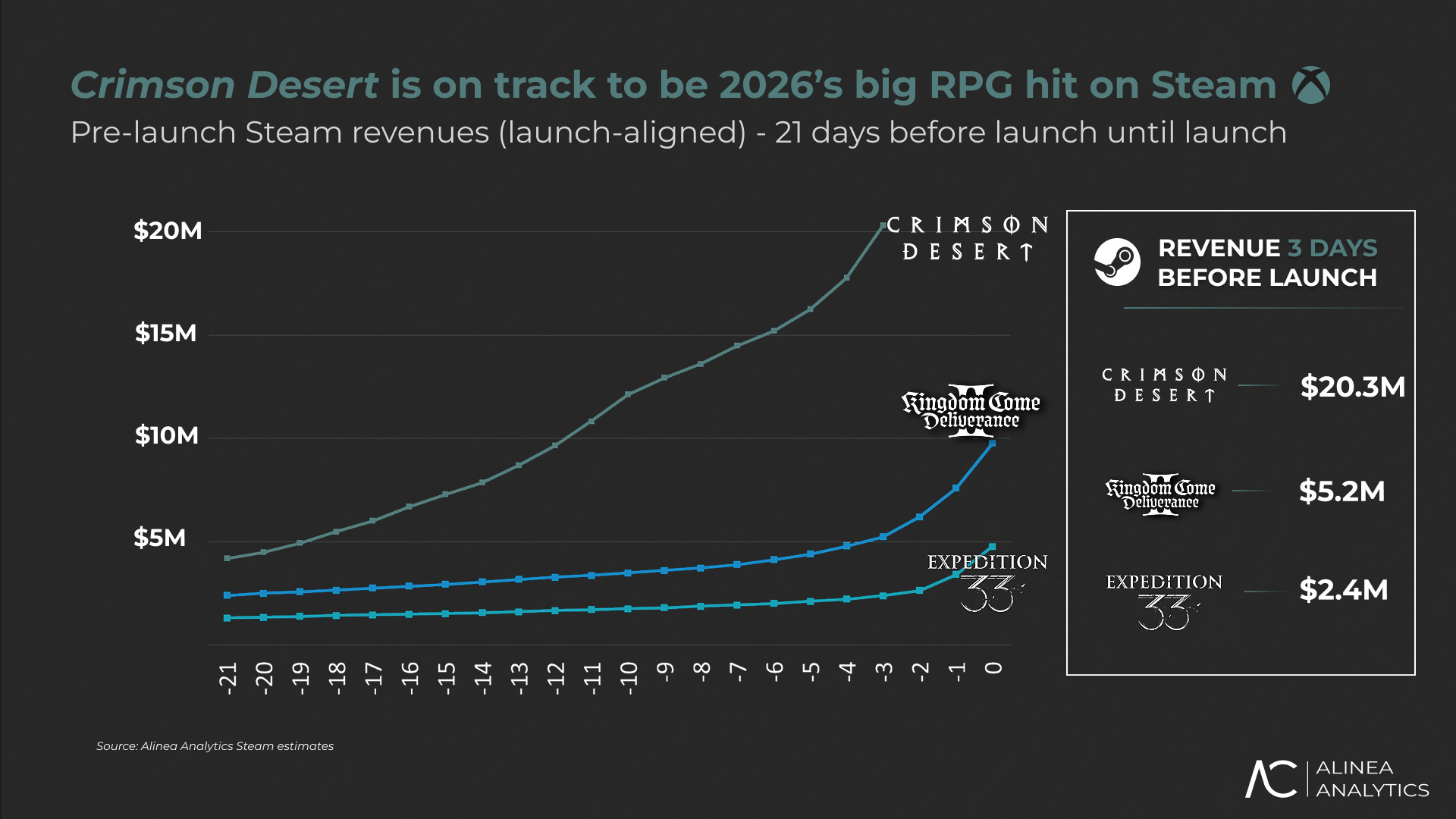
At the three-day pre-launch threshold, Crimson Desert’s $20.3 million on Steam means it’s outperforming Kingdom Come: Deliverance II by nearly four times ($5.2 million) and Expedition 33 by almost ten times ($2.4 million) at equivalent stages in their respective product lifecycles.
Nevertheless, it’s crucial to consider the extended post-launch revenue trends to gain a complete understanding:
The long-term data for Expedition 33 and KCD2 demonstrates that a strong initial performance merely lays the groundwork. Both titles experienced sustained revenue growth—reaching $95.5 million and $101.3 million on Steam respectively by day 120. This success was driven by delivering outstanding, critically acclaimed experiences that fostered long-term word-of-mouth engagement.
For Crimson Desert, the initial fervor has successfully met all pre-launch benchmarks, but now Pearl Abyss must prove its mettle. If the quality of Pywel’s open world and its sandbox elements fail to live up to the promising trailers and previews, that momentum will be swiftly halted, preventing it from achieving the lasting success witnessed by KCD2 and Expedition 33.
Several factors are currently in Pearl Abyss’ favor:
-
The sheer diversity of gameplay mechanics and the potential for emergent scenarios make it ideal content for streamers. I anticipate a plethora of viral clips on TikTok.
-
Pearl Abyss benefits from a substantial built-in audience derived from the Black Desert ecosystem, offering a loyal player base that new IPs seldom enjoy.
-
Their localization strategy is robust. Providing full voiceovers in English, Korean, and Simplified Chinese was a shrewd move that will resonate strongly in Asia. We observed this strategy serving as a significant driver for Stellar Blade’s triumph on Steam.
However, Pearl Abyss has overlooked regional pricing. While the U.S. and China lead the wishlist rankings, the presence of Brazil and Russia in the top five indicates a missed opportunity.
Pearl Abyss’ decision to adhere to a uniform global price risks excluding emerging markets where the equivalent local cost becomes prohibitive—a stark contrast to Stellar Blade, which leveraged regional pricing to dominate the Chinese market.
The $70 price point might also pose an initial hurdle to widespread adoption for more cautious players, though future strategic discounts will eventually help convert the “claim-and-wait” audience we frequently discuss at Alinea HQ.
The initial hours can also be quite overwhelming due to the rapid introduction of new features, which might deter some first-time users. But then again: Elden Ring has sold nearly 40 million copies, despite its steep learning curve.
Ultimately, Crimson Desert’s ultimate success hinges entirely on its execution. The community engagement and marketing efforts have been superb, and all pre-launch indicators suggest a monumental debut.
Assuming they don’t stumble, I believe we are looking at Steam’s second new $150M+ powerhouse for 2026. Unless, of course, the game fails to meet its ambitious promises. We’ll be analyzing its launch metrics (across both console and Steam) in next week’s newsletter, so make sure to subscribe below to receive it directly in your inbox as soon as it’s published.
Before we shift our focus to Xbox, and as some readers have inquired, Resident Evil Requiem has now generated over $500 million across all platforms, with $225 million attributed to Steam. Across Steam, Xbox, and PlayStation, Requiem has sold 5.7 million copies, according to our estimates.
My time at GDC this year was fantastic! Amidst numerous meetings, hosting panels, and reconnecting with old acquaintances—and making new ones—in hotel lobbies, I also found the opportunity to delve into Xbox’s new ‘console’.
As we previously commented to GameSpot earlier this week, Project Helix signifies Xbox’s final transition away from traditional consoles. While it will support Xbox console games, the clear intention is to guide fans towards PC gaming. This, however, will not be an easy undertaking.
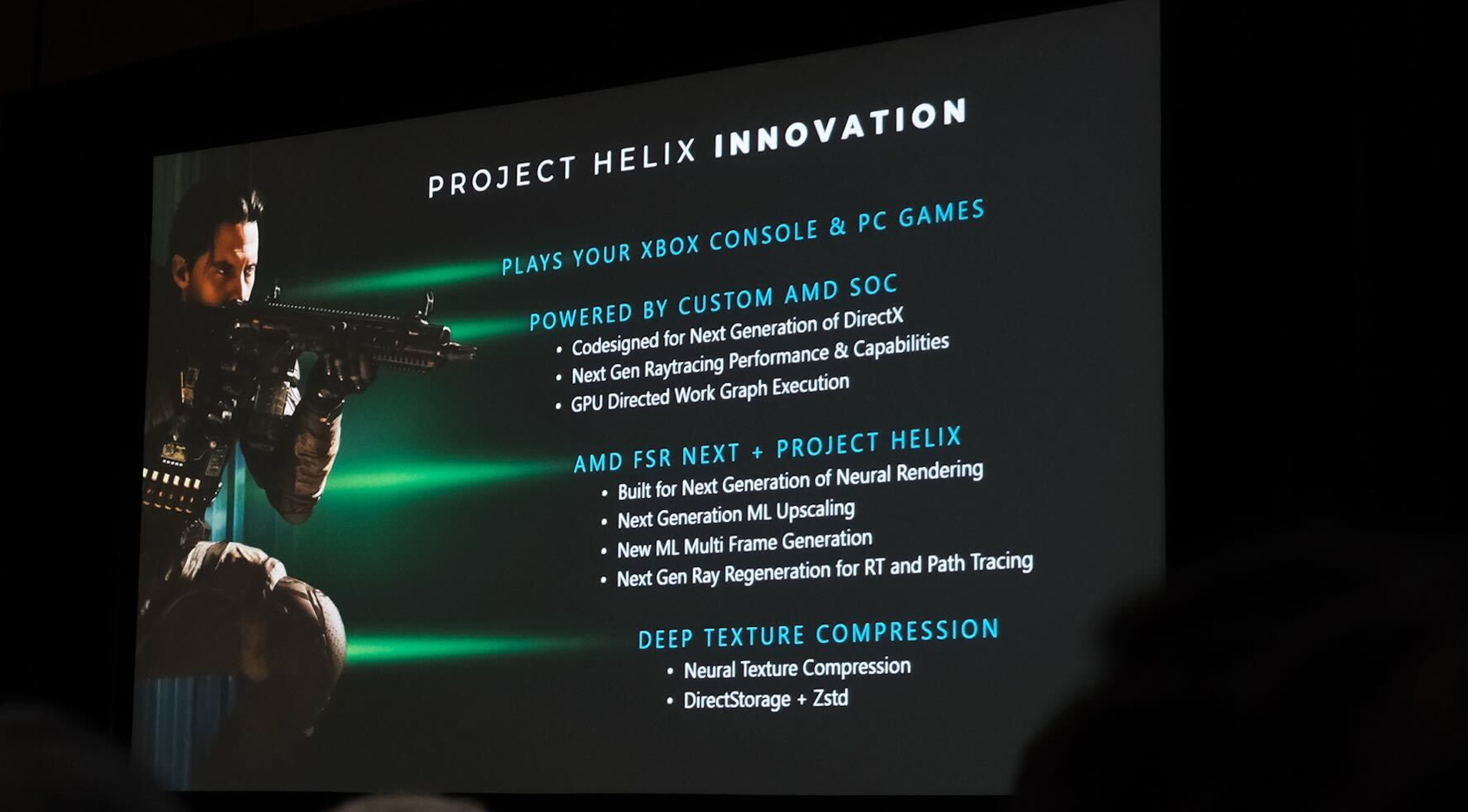
The “RAMageddon” phenomenon is a very real concern. The GDC presentations highlighted a custom AMD SoC and significant advancements in ray tracing, but the market realities are challenging. The generative AI boom has dramatically escalated demand for memory, driving component prices sky-high. The PS5 Pro already pushed the boundaries of premium hardware pricing—and even the Series X costs $650—so I anticipate Helix will retail for at least $850.
Historically, Xbox might have absorbed that cost to expand its market share, but current leadership is heavily focused on AI, operational efficiency, and profit margins. Like much of the tech sector, they have shifted away from the “growth at all costs” mentality prevalent during the pandemic. My impression is that if Helix is intended as a bridge to a PC-first future, Microsoft will expect consumers to bear a PC-level premium for it.
Helix’s market positioning is somewhat ambiguous. Microsoft is directly venturing into Valve’s territory here. Project Helix directly competes with the Steam Deck and Steam Machine. User friction presents a significant obstacle for Xbox. SteamOS offers an elegant, console-like experience, whereas the Windows interface tends to be more cumbersome. This dynamic could shift with the upcoming Xbox mode on PC, but my experience with the Xbox ROG Ally X hasn’t been particularly impressive.
Meanwhile, PlayStation appears to be pursuing an alternative path: reinforcing its proprietary ecosystem. While Sony will release live-service titles on PC to broaden their reach, they are reportedly reserving their core prestige games as exclusive hardware sales drivers.
If PlayStation continues to confine its premier titles to a proprietary ecosystem to safeguard its hardware, they are essentially wagering that their intellectual property holds greater value than the expansive reach of the PC market. Given the diminishing returns on PlayStation-developed game sales on PC, this might prove to be a shrewd gamble in the context of the Steam Machine and Xbox’s current strategy.
I don’t fault Xbox for its distinct direction. Project Helix represents a strategic pivot, necessitated by the Game Pass dream having reached its limits, which itself was born from the need for damage control following the disastrous Xbox One launch. Furthermore, during the pandemic, the industry overextended itself, making risky acquisitions based on the assumption of perpetual double-digit gaming growth.
In 2026, the attention economy is oversaturated, and the subscription model does not scale in gaming in the same way it does for music or film. A user can consume hundreds of songs monthly on Spotify, but typically has time for only a handful of major games.
Despite Xbox clearly losing mindshare to its rivals in recent years, Xbox still commands tens of millions of devoted users with extensive digital game libraries. Rather than seeing them migrate to a PC or a Steam Machine when they outgrow the console cycle, Helix provides a transition path to a Microsoft-approved hybrid system.
It acts as a lifeline—to extend my unfortunate nautical metaphor—to transition their most significant spenders into a PC-first ecosystem without sacrificing their existing digital library through Play Anywhere. In essence, it represents the ultimate evolution of the strategy initiated with the Xbox One.
With Helix, Xbox aims to harness the flexibility of the PC market while preserving the plug-and-play fidelity valued by console enthusiasts. Given its elevated price point and the persistent ramifications of the RAMageddon, Helix’s success will be entirely contingent on whether Xbox Mode on Windows genuinely offers a smooth experience or merely adds another layer of Windows bloatware.
If it fails to achieve this, Helix risks alienating Xbox’s most dedicated fans, leaving them with an over-priced hybrid that lacks the elegance of a Steam Machine or the prestige of a PlayStation. Marketing will also play a crucial role. Hopefully, their departure from the “This Is an Xbox” campaign signals more innovative approaches ahead.
Healthy competition fuels innovation. Should Project Helix succeed, it could exert greater pressure on Valve’s dominance in the PC market. Similarly, the industry suffers when Sony and Nintendo are allowed to become complacent without a credible challenge to their hardware paradigms.
A successful, high-end hybrid offering from Microsoft would, in my estimation, be a beneficial development for the market.
We are currently providing a complimentary trial of our platform for games companies.
Reach out to us here, or simply reply to this email, and we will get you set up.
Please reply to this email—or contact us via this link—if you have any feedback regarding the newsletter or wish to request coverage for a specific game.
[Alinea Analytics prides itself on providing the most accurate PC and console estimates in the industry. Game developers leverage our platform to gain insights into their audience, monitor competitors, track sales trends, and identify new opportunities. We equip game studios and financial institutions with precise data and the confidence to make smarter, data-driven decisions. Interested in discussing gaming market data? We’d be delighted to connect!]