At a glance
- During a nationwide measles-rubella vaccination drive last October, local health workers discovered a severely disadvantaged family in Lesotho’s Leribe district.
- Mabafula Ntšihlele and her ten children lived in extreme poverty, making the USD 1.50 cost of an immunisation booklet and the bus fare to a health facility impossible to afford.
- Health workers not only delivered vaccines directly to their home but also extended their help by gathering donations of food, clothing, and bedding. ‘Mamoferefere Zim, the head of nursing at the nearest hospital, stated their goal was to safeguard not only the family’s health but also their inherent dignity.
In Khanyane, a rural community nestled on the forested slopes of the Fothane Hills in Lesotho’s Leribe district, a solitary brown clay structure functions as both kitchen and bedroom.
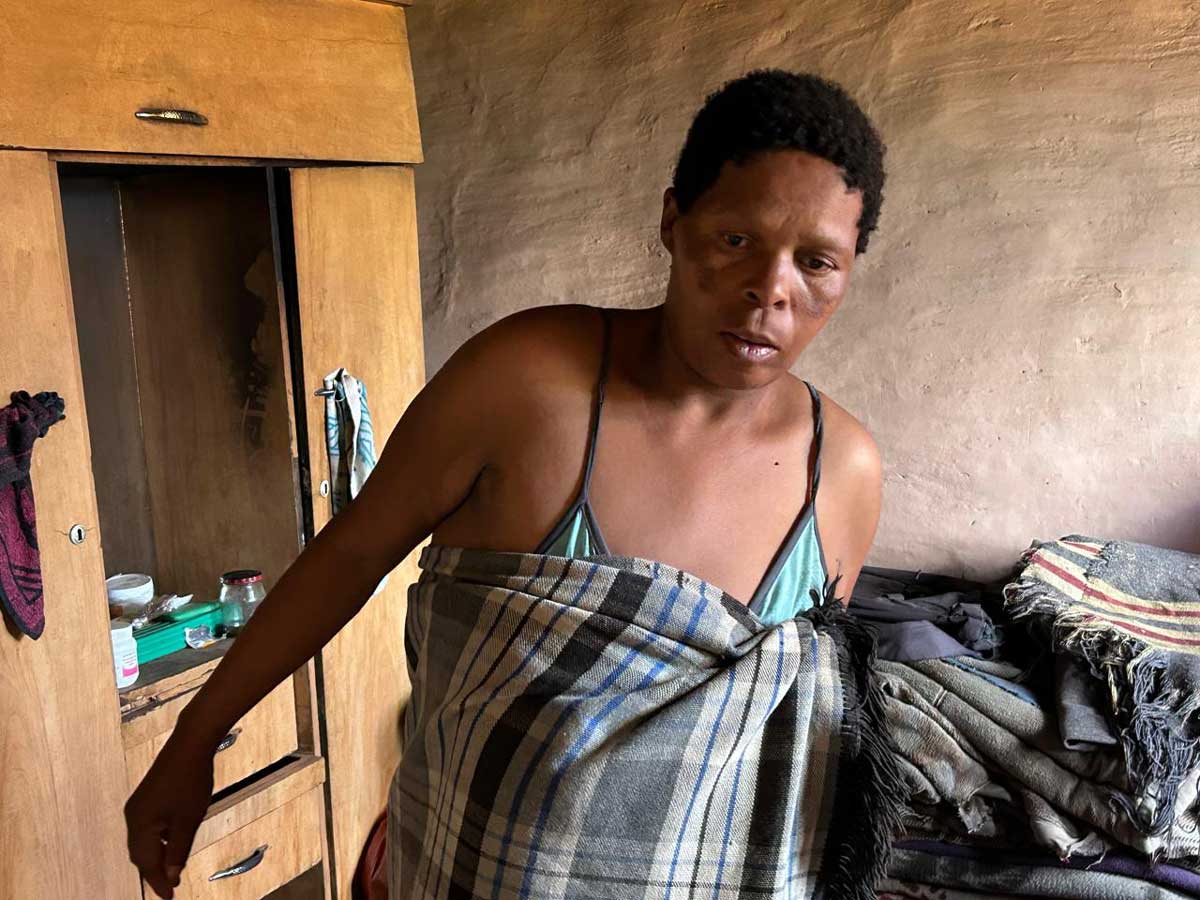
Quiet domestic scenes unfold around the dwelling. Outside, three barefoot children, all under five, stir up dust playing by the entrance. Inside, their 35-year-old mother, Mabafula Ntšihlele, breastfeeds her one-month-old infant, reclining on her left side on a double bed.
Soft light streams through the lone window above her bed, illuminating the dim, sparsely furnished room, heavy with the scent of wood smoke – a place where daily existence, repose, and mere survival intertwine.
“I have ten children. Half were delivered in a hospital, and the other five were born at home simply because I lacked transport money,” Ntšihlele explained. Her home is about ten kilometres from Motebang Hospital, the closest health facility.
She clarified that none of her children had received their routine childhood vaccinations by the end of October 2025, a situation stemming not from personal belief or parental neglect, but from profound poverty. She was unable to afford the US$ 1.50 medical booklet mandatory at health facilities, nor the approximate US$ 1.60 for return transport to Motebang Hospital.
To Ntšihlele, these modest amounts – less than the price of a single meal in numerous global regions – proved insurmountable, effectively placing life-saving healthcare out of her children’s reach.
“I sustain my family through occasional piece jobs, and every cent I earn goes towards purchasing just one kilogram of maize meal for my children,” she informed VaccinesWork last November, shortly after Lesotho wrapped up its national measles and rubella vaccination drive.
When absence raised alarm
From October 20 to 25, 2025, Lesotho implemented a comprehensive nationwide measles and rubella vaccination campaign. The Minister of Health, Selibe Mochoboroane, explicitly directed village health workers to ensure every child received the vaccine.
“To all village health workers: you are aware of every child under five residing in your village. We expect no child, not a single one, to miss this vital vaccine,” Mochoboroane emphasized during the campaign’s inauguration speech.
Khanyane village health worker Makoetle Koetle heeded the directive rigorously. Noticing Ntšihlele’s children under five were absent from the temporary village vaccination site, Koetle promptly notified the nursing team.
“Children suffer when they witness others receiving services from which they are excluded. This is precisely why I brought the family to the attention of the nurses,” Koetle stated.
The report made its way to ’Mamoferefere Zim, who manages nursing services at Motebang Hospital and oversaw the vaccination campaign in Leribe district.
“Despite being told the village was unreachable by car, I felt an obligation to go,” Zim recounted.
A difficult journey, a stark reality
Their journey proved challenging. Zim and her team traversed a stream and followed forested trails to reach the family’s home, aiming to ascertain why the children had missed out on vaccination services.
Upon arrival, they discovered four children under five: a two-week-old baby, an 18-month-old toddler, a three-year-old, and another just shy of five. None possessed medical booklets.
Ntšihlele’s husband initially greeted Zim, indicating no opposition to his children being vaccinated. As she was about to depart, he requested she enter the house to converse directly with Ntšihlele.
Inside, Zim witnessed deeply troubling conditions. The family inquired if permanent sterilisation could be arranged for Ntšihlele. Zim noted a solitary thin mattress, its occupant unknown, and threadbare blankets clearly inadequate for the household’s needs.
“It was clear there was no maize meal in the house, not even enough for a single meal. The children lacked proper clothing,” Zim commented.
By the visit’s conclusion, an understanding was established: nurses would revisit the homestead to vaccinate the four children under five, including giving a BCG vaccine to the two-week-old infant. Zim also arranged for medical booklets for both the children and Ntšihlele.
Beyond vaccination
“Upon evaluating the circumstances, it was evident this wasn’t merely a situation of a mother neglecting to bring her children for vaccination,” Zim explained. “When securing daily food is a constant battle, undertaking long journeys with young children for immunisation becomes exceedingly difficult.”
Zim stated her assessment pointed to poverty as the main impediment. Following this, the children received their vaccinations, and she liaised with doctors at Motebang Hospital to facilitate Ntšihlele’s request for permanent sterilisation. Ntšihlele was then transported from her residence, admitted to the hospital, and underwent the procedure.
During Ntšihlele’s hospital stay, Zim reached out to her colleagues for aid. Public servants contributed, providing donations of food, clothing, blankets, and a bed – the very bed on which this reporter observed Ntšihlele sleeping in November 2025.
“The assistance offered far exceeded what was expected and contributed significantly to restoring the family’s dignity,” Zim remarked. “Upon her discharge, Ntšihlele went home with these generous donations. Our ongoing priority is to guarantee the children receive their regular vaccinations.”
Zim noted that this instance highlights a wider systemic issue in healthcare. “Frequently, our focus is on service provision, yet individuals are unable to access these services due to financial constraints,” she explained.
Leveraging her background in community health, Zim elaborated that poverty commonly acts as the most significant barrier. “For a woman like Ntšihlele to bring three children for vaccination, she needs transport money. She must be able to feed her children while waiting. She needs nappies, clean clothes, and dignity. At the clinic, the cost of poverty becomes visible.”
A changed outlook
Ntšihlele expresses newfound confidence in her ability to take her children for their routine immunisations.
“I consistently wished for my children to be vaccinated. Now that they possess medical booklets, I will secure funds for transport to Motebang Hospital, even if it means borrowing,” she declared.
She attributes the profound support, extending beyond medical treatment, to the nurses and village health workers. “They didn’t just assist with the booklets. They delivered food, clothes, a bed, and blankets. They could have simply departed after vaccinating my children, but instead, they photographed my home to solicit further assistance from others,” Ntšihlele recounted.
“Back then, we had endured two days without food. Now, my worries are significantly reduced.”
She observes a clear transformation in her children. “Upon my return from the hospital, my children were underweight, and we had no food. Now, I can witness the change in their physical condition – their weight is getting better. It’s an immense relief. Presently, I feel no stress.”