I first encountered 24-year-old freestyle skier Rell Harwood last October at the U.S. Ski and Snowboard’s annual fundraising event in New York City. We shared a table sponsored by J.Crew, the official lifestyle apparel partner for the sport’s governing body. Initially, it seemed unlikely we’d have much in common: I, a fashion editor in Manhattan with minimal mountain exposure, and she, a Park City native who began skiing at age three. However, when the evening’s host introduced Harwood and highlighted her hobbies beyond the slopes, our connection became clear. Like me, Harwood enjoys shopping, and thrifting is her particular passion. Once she joined the dinner table, we had ample subjects to discuss.
During the evening, I inquired about Harwood’s skiing career, her Olympic aspirations, her thrifting adventures, and the upcoming J.Crew campaign she was involved with. The day after the gala, she departed with seven other athletes for Austria to film Alpine People, a short movie and accompanying advertisement celebrating the inaugural collection from J.Crew’s three-year collaboration with U.S. Ski and Snowboard. The Stifel U.S. Freeski Team member and X Games gold medalist was joined by Colby Stevenson, Hailey Langland, River Radamus, Tess Johnson, and Zach Miller. Each athlete embodied a distinct mountain persona; Harwood’s was the “Après Aficionado,” described as a “cocoa connoisseur and queen of the après-ski happy hour.” This was a role she enthusiastically embraced and identified with fully. “I got lucky,” she later confided to me via Zoom, weeks after the collection’s January 8 launch. “That kind of is me,” she quipped. “It was perfect.”
While the J.Crew collaboration significantly broadened her interest in fashion, Harwood’s foremost objective leading up to Cortina remained unchanged: securing her spot in her inaugural Winter Olympics. When we reconnected in Aspen, Colorado, during the Toyota U.S. Grand Prix in mid-January, her qualification was still uncertain. She had recently sustained another injury—a familiar challenge in her professional career—yet she assured me she would push through, determined to compete for her nation. Just a few days later, she excitedly updated me on her status. “I just qualified for the Olympic team,” she revealed. “A lot of circumstances had to align for [this] to materialize, so I’m incredibly thrilled.”
In the Milano-Cortina Games, events haven’t unfolded as anticipated, but Harwood has consistently overcome obstacles. On the day she was scheduled for her initial Olympic event, she did not participate, later clarifying the situation on Instagram. “I didn’t compete at the Olympics today, but my time here isn’t done,” she began, detailing how she tore her right ACL just weeks before this year’s Games—a recurrence of the injury she suffered before the 2022 Winter Olympics. “At that point, I honestly lost hope,” she confessed in her post. “There was no time for surgery, and even beyond the Olympics, I was devastated to not be able to ski. I genuinely love this sport more than anything, and it completely broke my heart.” However, her surgeon presented an alternative: skiing without an ACL, a feat recently accomplished by fellow Team USA skier Lindsey Vonn. “With guidance from my medical team, I decided to go for it,” she wrote.
To conserve her energy, she opted out of slopestyle, which would have been her first event, prioritizing big air instead. “Jumps have felt better than rails, and I want to give it my all.” The qualifications for this event are scheduled for Valentine’s Day, with the finals two days later.
Below, delve into Harwood’s life, both on and off the mountain, before her Olympic debut.
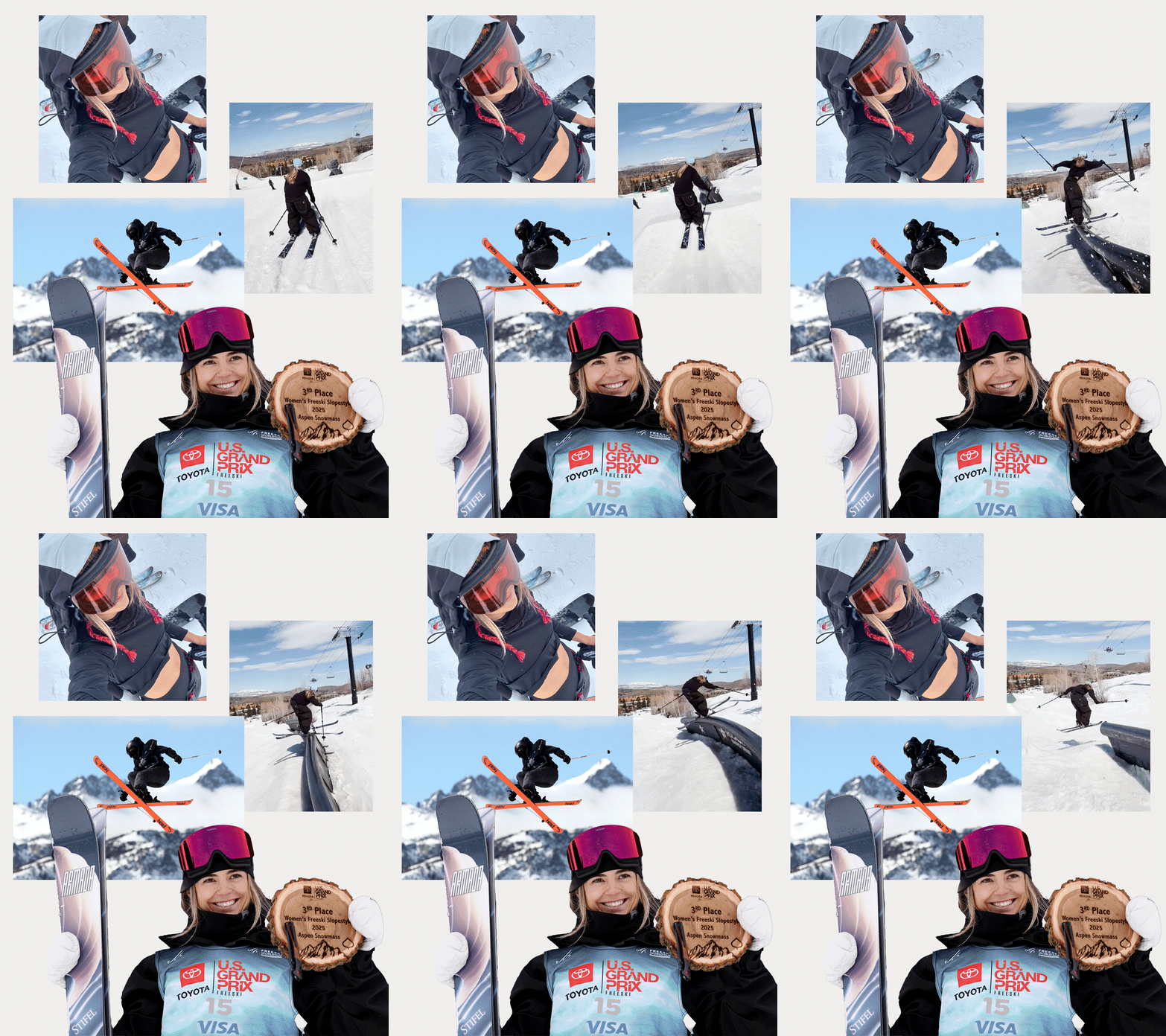
Let’s discuss your introduction to skiing—I understand you didn’t initially enjoy it. What sparked the change?
My parents introduced me to skis at age three, and around seven, I enrolled in the “Learn to Race” program at our local mountain [in Park City], which focused on racing fundamentals. But I never truly connected with it; it just wasn’t for me. We’d often pass the park, and I’d ask, “Can we try the little jumps?” They’d always reply, “No, not here.” Eventually, my parents enrolled me in a free ski program. While they ski and snowboard, they aren’t deeply involved, so they didn’t even know what free skiing was, but thought, She’ll find this enjoyable. They put my brother and me in it, and I absolutely loved it. I was an adrenaline junkie from a young age, and that’s when I truly began to enjoy skiing.
It’s fitting, then, that you’re also a creative individual.
Indeed, my sport demands immense creativity. Everyone strives to discover unique lines and innovative tricks on the course.
Before skiing became your professional career, it was merely a hobby. Could you describe that period and how your perspective had to adapt?
It’s undeniably very different from my initial days. Early on, it was simply about having a blast with friends and trying daring tricks. Then, I had to transition, thinking, Okay, now I’m on the U.S. team, and I’m competing in international events. Yet, for me, it remains something I adore and find joy in. If I didn’t love it, I wouldn’t do it. Of course, there are days when I feel, Okay, this is extremely challenging. But even recently, with numerous injuries [preventing me from skiing], it helps me recall how much fun it truly is. I cherish it more than anything else in the world.
You’ve experienced significant highs, such as your X Games debut and the gold medal the following year, alongside lows, like the injuries you’ve faced recently and in 2022. How do you find equilibrium when navigating these contrasting extremes?
They are certainly poles apart. When I’m in those deepest lows, it’s crucial to remember the incredible highs [and remind myself that] I will bounce back. I have to undertake steps I might not necessarily want to, but I know I’ll return to experiencing those amazing feelings again. I believe having endured both ends of the spectrum actually helps in a way.

What measures did you take after being injured to regain your confidence and focus, and return to the sport?
It’s undeniably difficult, demanding substantial mental resilience to push past the daunting aspects. However, time also plays a role; the more you return to the snow and execute maneuvers you recall doing confidently, the more that assurance gradually builds, leading to improved feelings. I’ve been fortunate with each of my injuries because I can effectively compartmentalize everything. I believe many skiers do this; they must tune out all the intimidating parts and assert, This is my purpose. This is what we’re going to achieve.
You mention this is a common experience among skiers. How has being part of a team, even in an individual sport like yours, supported you during such times?
It’s truly remarkable. Even though it’s an individual sport, it functions very much like a team sport. I spend over half the year traveling with my team; we’re all incredibly close. I’ve grown up with the women I ski alongside, so having that robust support system is invaluable. I think almost every woman on the professional team, at least, has experienced a knee injury [like mine], so they understand the yearlong rehabilitation process and everything that entails.
Conversely, when it comes to your victories, could you highlight some of your career’s standout moments?
One of the most significant highlights of my career was my first appearance at the X Games, which occurred two years ago [in 2024]. I competed in Slopestyle, Big Air, and Knuckle Huck, and I was simply ecstatic to be there—I didn’t anticipate any particular outcome or a podium finish. I ended up having an incredible time, securing second in Knuckle Huck, third in Big Air, and fourth in Slopestyle, just missing the podium there. I believe that’s when I perform my best skiing, when I’m genuinely enjoying myself, and clearly, it showed. I was completely stunned—I hadn’t expected it to happen. And then returning the following year to win gold in Knuckle Huck was just surreal. I grew up watching all those women do it from such a young age, and now, to be doing it myself, is still so unbelievable.
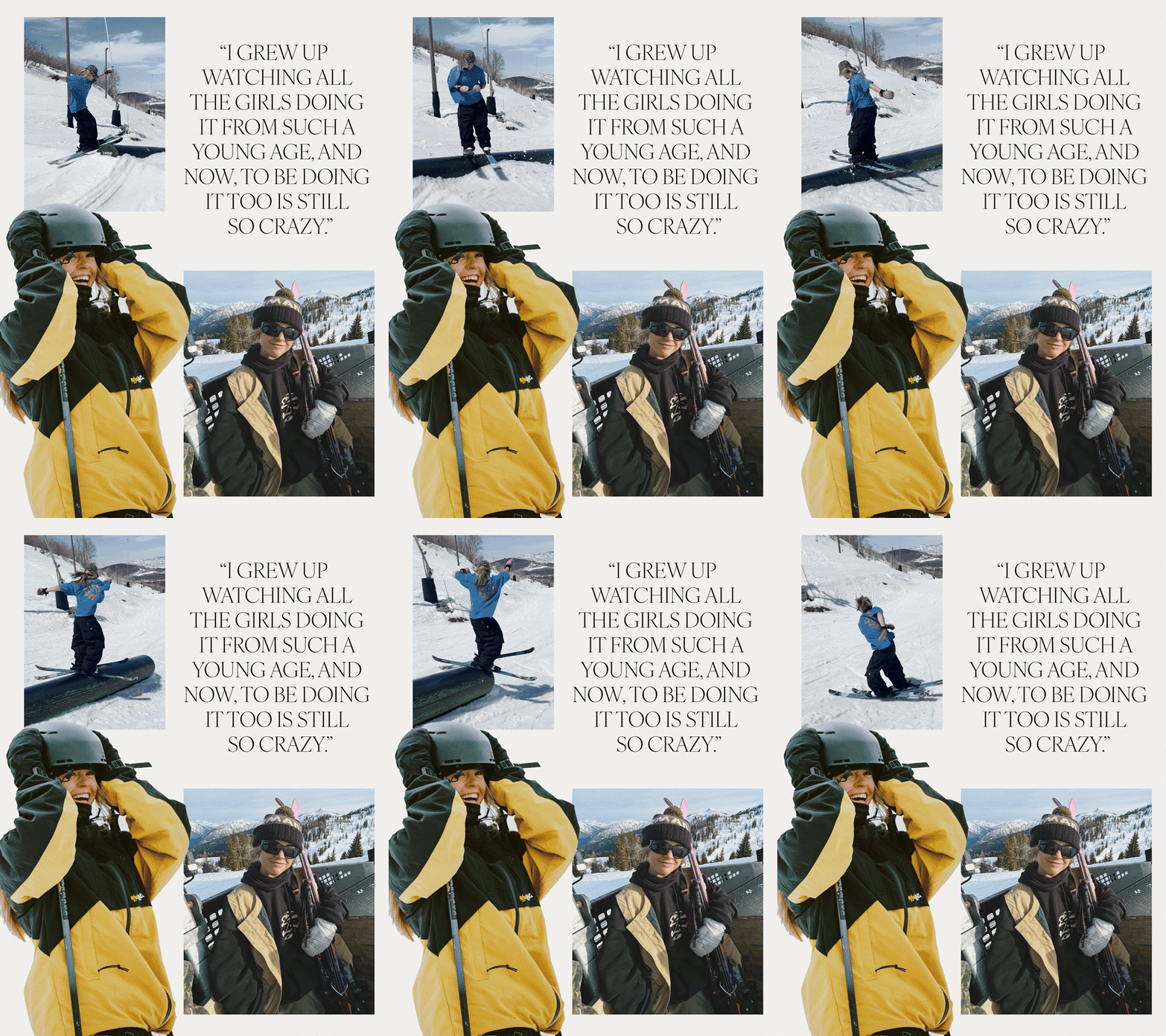
How do you believe skiing has shaped you into the individual you are today?
I’ve never adhered to a rigid lifestyle, like attending school and then working a traditional 9-to-5 job. I’ve always asked myself, What else can I pursue? Even before I understood what professional skiing entailed, and that I could forge a career from it, it offered me a unique path—to travel as a living. I did attend college and earned a degree, but it’s wonderful to have this opportunity, at least for now, to engage in something so completely different with it.
I’d like to touch upon fashion. How did your interest begin, particularly regarding secondhand shopping and thrifting?
In my sport—specifically slopestyle—self-expression through clothing choices is paramount. We experience trends and phases, much like mainstream fashion; currently, large, baggy clothes are popular, reminiscent of the early 2000s when professional snowboarding was gaining traction. Some individuals adopt an edgier look with striking belts and chains. It’s incredibly diverse and unique for everyone. I believe I really started getting into it a few years ago because I simply wanted to stand out. I think it parallels my tricks too—I aim for uniqueness in both my tricks and my style, much of which I could achieve through thrifting. I’ve always had an affinity for items from the early 2000s. I also have sponsors, like an outerwear sponsor, so I enjoy pairing those pieces with my thrifted finds, mixing and matching old with new. I love being creative with it, and every time I put on a truly cool outfit, it makes me even more eager to ski that day.
I frequently hear that “look good, play good” mentality from many athletes.
It’s absolutely true.
Do you manage to find time for thrifting during your travels?
Yes, I went thrifting just yesterday. Sometimes in Europe, we don’t have as much time, but I’ve likely visited a thrift store in nearly every place I’ve traveled to over the years.
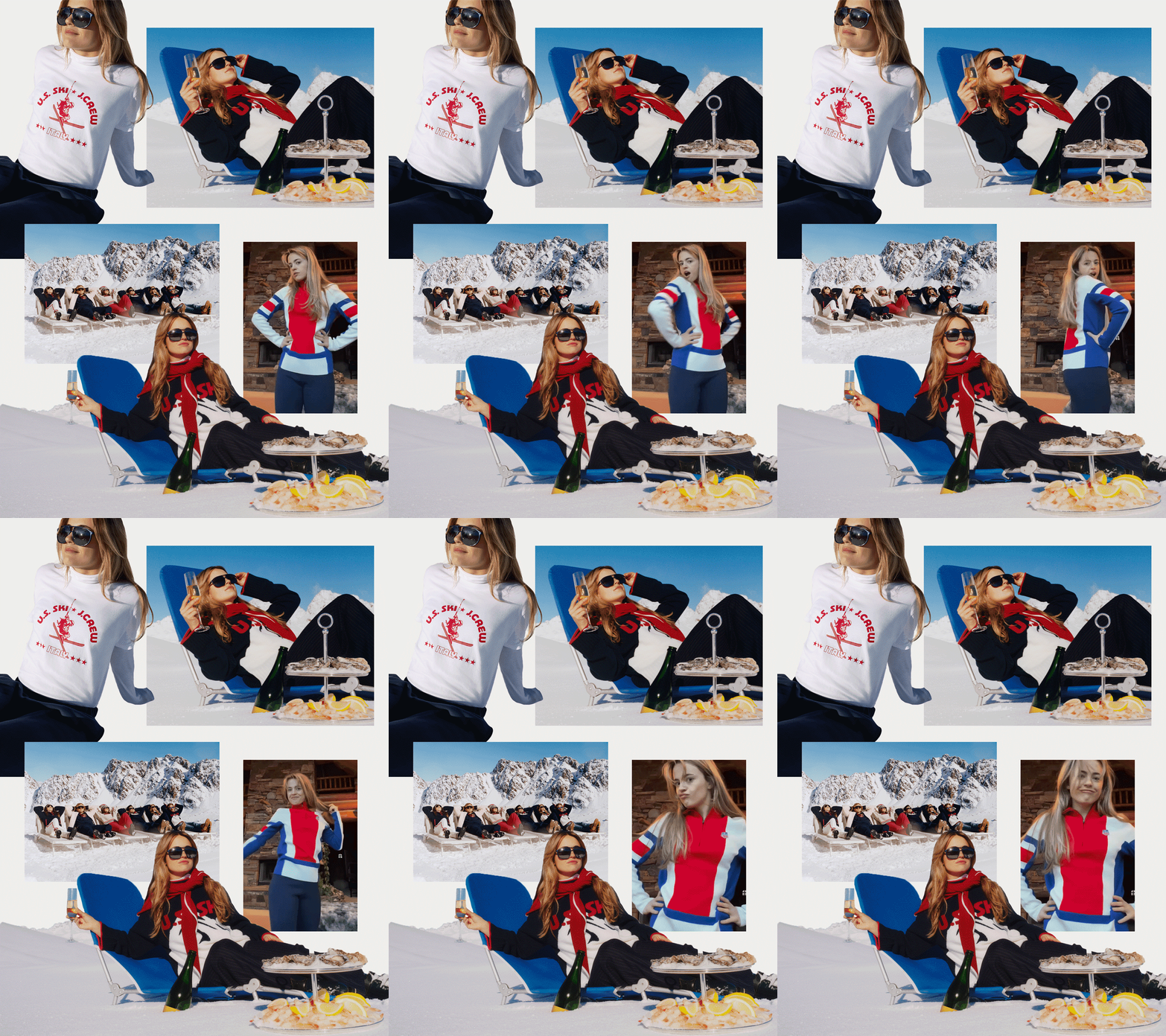
Given your passion for fashion, how did you react to the news that you would be featured in a J.Crew campaign?
I was somewhat speechless. It took such a long time for all the details to fall into place, so I kept thinking, Is this actually going to happen? It almost felt too good to be true. When it finally did, I was like, What? They want me?
You certainly landed the perfect character role.
I know, I got fortunate. [Après Aficionado] genuinely is me. It was flawless.
Speaking of the photoshoot, could you describe that day for me?
It was a truly fantastic experience. I’ve visited Austria several times before, but never that particular region. I had been in Austria for about two weeks prior, and we hadn’t seen much snow. However, the night before the shoot, it snowed profusely. On our ascent to the mountain, they had to plow the roads, a tree had fallen, and it took ages to reach the top, but it was absolutely stunningly gorgeous once we arrived. Everyone was like, Thank God. It couldn’t have worked out better. It was also really cool because the other athletes—I’m close with Colby Stevenson since he’s on my team—but Hailey Langland, Tess [Johnson], River [Radamus], and everyone else, I don’t typically know them that well because we all travel to different locations and adhere to demanding schedules. So, it was lovely to chat with them about how our winters were progressing and the Olympics. And then interacting with people from all over the world, like those from J.Crew in New York—everyone was so kind. All in all, it was a truly great experience.
Did participating in a more fashion-oriented project with J.Crew heighten your interest in pursuing similar opportunities in that field?
Absolutely! I would eagerly embrace any such opportunity that arises.
Looking ahead, what does the remainder of your year hold?
I just secured my spot on the Olympic team yesterday. Many factors had to align for it to happen, but I’m truly excited because it will be my first Olympics.

Congratulations! How do you feel about this achievement?
It truly represents a monumental milestone I’ve been striving for my entire life. Even as a child, I declared, I’m going to the Olympics, though back then I didn’t truly grasp its magnitude. Then, when my sport was included in the 2014 Olympics, I realized, Wait, I actually could go to the Olympics. After sustaining an injury right before the 2022 Olympics, and then another right before this one, it was completely uncertain whether it would happen. But it is going to happen. Immediately afterward, I’ll likely undergo knee surgery. So, it’s a lot to manage, but I get to go and compete for my country. My entire family will be there, so I’m incredibly excited.
Plus, Milan offers unparalleled thrifting opportunities.
I know. I definitely have to go.
With these two enormous events unfolding, what goals would you hope to have accomplished, or what emotions would you like to be experiencing, by the end of 2026?
That’s a tough question. My primary goal is simply to participate in the Olympics and exert my utmost effort, regardless of whether that results in a podium finish. As long as I perform something I’m proud of—a run I’m thrilled with—that’s all that truly matters to me. Afterward, I’ll focus on a successful rehabilitation process. Hopefully, everything goes smoothly so I can return to skiing. I would love to be back on the snow before the year concludes. I am far from finished. This career in skiing, and everything associated with it, is something I intend to pursue for quite some time longer.