In July 2012, Damascus plunged into chaos, and I gained a profound understanding of what being a revolutionary truly entails. It wasn’t the glorious journey one might anticipate, but rather a more intimate, sorrowful, and human experience. The constant grip of fear alienated partners and companions, revealing that it did not purify us of our inherent flaws.
That summer marked approximately a year since Syria’s democratic uprising began and was met with brutal repression. Militias had started clashing with the national army. I was residing in the apartment of my friend Amer, a Christian artist who had quietly opposed the government long before the rebellion.
Each evening brought the distant thud of bombs and the sharp crack of gunfire, reminiscent of fireworks. The mountain overlooking the city—a place we once visited for cafes, shisha lounges, and scenic vistas—had become a military exclusion zone. Daily protests ceased abruptly. People were vanishing; some intentionally fled the country, while others simply disappeared without a trace. Security forces initiated widespread arrests and carried out on-the-spot executions.
The reports from the city’s hospitals were so ghastly, I questioned their veracity: injured individuals reportedly chained to beds while doctors, accompanied by security personnel, poured rubbing alcohol into their open wounds; physicians allegedly burning the genitals of detainees. Many bombing victims so dreaded these tortures that they opted for treatment in living rooms converted into makeshift field hospitals. There, limb amputations became routine, and shrapnel was extracted from festering wounds without anesthetic.
Consequently, that July, Amer’s refrigerator, typically stocked with water and fruit, became a cooler for tetanus vaccine vials. I neither knew nor inquired about their acquisition. They might have originated from those very hospitals, smuggled out by a doctor who perhaps performed acts of torture to affirm loyalty and maintain access.
For several weeks, my task was to deliver the vaccine to areas housing these improvised medical centers. I would retrieve the needles from the fridge, encasing them in a towel I’d chilled overnight in the freezer. On the public minibus, my bag was discreetly placed beneath my seat. I was aware that searches could occur at any checkpoint. However, I also knew that if the tetanus shots were discovered, I could simply disavow ownership, shifting blame to an unsuspecting passenger nearby.
My loyalty would remain unchallenged because my identity card indicated my hometown, identifying me as an Alawite—a member of the religious minority that formed the foundation of President Bashar al-Assad’s authority. Furthermore, my surname belonged to a family with close ties to Assad’s inner circle. I had arrived in Damascus five months prior, when the nascent democratic protests compelled me to confront a truth I had long suppressed: a regime I was taught to see as a protector was, in fact, the wellspring of the oppression I both witnessed and personally endured. I was prepared to break away from my father’s influence and challenge every belief instilled in me as a daughter and an Alawite.
I discreetly joined early protest gatherings, forsaking the privileges my family name once afforded me—yet I also recognized that this very protection could prove detrimental. If exposed, no penalty would be withheld. I recalled an Alawite demonstrator who had fled the country after being shot in the leg and detained. His captors repeatedly stomped on his injured limb, and for weeks, they claimed his sister was being raped in an adjacent cell, promising her release only if he divulged every name he knew. Convinced he heard her screams, he eventually provided a few names. Later, he discovered his sister had never been imprisoned. “When an Alawite is caught,” he recounted to me later, “they ensure you become an example. Our disloyalty to them isn’t merely political; it’s viewed as a profound betrayal of their trust in us. Our treachery is equivalent to a thousand betrayals.”
I consistently delivered the hypodermics to a small shop at the entrance of a district known as Barzeh. The owner, a man of middle age, we referred to as Al Hakeem. “I’m returning this,” I would say, placing the bag inside an ice-cream freezer adorned with a smiling snowman wearing a red scarf. One day, Al Hakeem’s young son was present, clinging to his father’s leg, hiding behind him.
“I am doing this for him,” Al Hakeem uttered. These six words were the only ones he ever spoke to me. He vanished shortly thereafter, and before I could grieve for the boy, I felt a sense of relief for having maintained my silence around Al Hakeem, offering no clue as to my identity.
Just two miles separated the makeshift field hospitals and the grim reality of amputated limbs in Damascus’s outer districts from Bab Sharqi, the city’s ancient heart. On its narrow, cobbled lanes, the sweet scent of flavored tobacco still drifted from hookah bars; water gently splashed in fountains, jasmine bloomed, and art galleries transformed into clandestine speakeasies. Here, the elite danced and sipped martinis and wine, perhaps contemplating what kind of “freedom” the disaffected masses were demanding for Syria.
Among the bars in Bab Sharqi was a rustic establishment named Abo Elia, after its white-haired proprietor, who spent his evenings preparing meze platters and mixing drinks. My friends and I often ended up there. Abo Elia’s beverages were the most affordable in the vicinity, and one could easily acquire a complimentary drink—or even five. Abo Elia declared he kept his bar open despite the conflict as a testament of his love for his homeland.
“The terrorists seek to disrupt normal life,” he would lament while arranging cucumber and carrot slices on our plates. “I refuse to grant them that satisfaction. May God bless our army!”
“God bless our army!” we’d echo in unison, clinking our glasses as Abo Elia refilled them for free. He addressed us as his rifaaq, his “comrades”—unaware that we were aligned on opposing sides of the conflict.
We played along, drinking for hours. The bill consistently covered only a fraction of the alcohol we consumed, and we’d depart the bar, giggling and tipsy, praising the army and vowing to one another never to disclose how we had compromised our principles and cheered our oppressors, all for free splashes of vodka with grapefruit juice.
One morning following a night out, I awoke fully dressed in bed. I discovered my phone beneath my pillow. Its battery was depleted. After plugging it in, I saw a message from my friend Walaa, who had been with me at the bar the previous night, requesting an immediate call.
I disregarded the text. My phone rang. It was Walaa. “Apologies, I just woke up,” I stated.
“I’m outside,” she informed me. “Open the door.” Moments later, she was forcing her way into the residence.
“Are you insane?” she snapped, and I was too mortified to inquire about her accusation.
“You need to stop drinking. You’re endangering yourself and everyone around you,” she warned.
Drinking alcohol had been an integral part of my Alawite identity since childhood. Consuming alcohol and walking without a headscarf were practices adopted centuries ago during Ottoman oppression to assimilate with Christians. Arak, the potent fig-based brandy, is distilled throughout the Alawite mountains and featured at every childhood dinner and barbecue, even at gatherings beneath pine trees near Alawite shrines, where we feasted on grilled meat from sheep my Aunt Samia sacrificed as a kafara after breaking a vow.
“Just a tiny sip!” my aunt would urge, holding a glass of milky-white liquid to my nose. Arak is believed to neutralize bacteria from raw kibbeh nayeh or unwashed parsley in tabbouleh. Children consume it, mostly with grimaces, as their parents and older relatives observe, laughing and jesting about how a true Alawite child can handle arak. It flows in our veins from birth.
Arak was reserved for intimate family gatherings. For weddings and other public festivities, whiskey—Black Label specifically—was presented as a symbol of affluence. A bottle of whiskey also served as the most common form of bribe for army commanders and intelligence officers.
I was 15 when I first experienced intoxication—on Black Label, with the daughters of my father’s cousin Hikmat, who managed the intelligence office in As Suwayda. It didn’t occur to me then that the bottle we drank from might have been a bribe from a parent desperate for information about a detained child. The last thing I recall from that night is lying on the sofa, my head in one of the girls’ laps, as we made prank calls from their no-caller-ID phone line—a privilege exclusively available to those with security clearance.
Now, Walaa’s ashen face confirmed that I had committed a serious error during the forgotten hours of the previous night. She recounted that the government had been shelling the rebellious outskirts of the city, a frequent occurrence. The explosions intensified to the point that the table vibrated, and I began to weep. Abo Elia reassured me not to be afraid.
“Syria Alla Hamiha,” he declared—“Syria is divinely protected.” “If a limb is cancerous, we excise it to preserve the rest of the body. This bombing is vital for the nation’s salvation.”
“You started arguing with him and refused to be quiet! I kept pinching you under the table,” Walaa exclaimed. She informed me that we could no longer frequent Abo Elia’s bar. I then realized I was fortunate to have awakened at home rather than at the police station.
“I apologize,” I said. “I will never consume alcohol again.”
This, of course, was a falsehood. Alcohol remained my sole reliable solace as circumstances continued to deteriorate.
By the end of that summer, most of my protest acquaintances had departed for Jordan or Lebanon. The remaining few of us sought refuge in various homes and apartments—relocating frequently, sleeping on couches in living rooms where we drank continuously, day and night.

One day, Amer and I met at a coffee shop with a friend of his who was preparing to leave Syria. Samar was betrothed to a journalist and former detainee who, upon his release, received an arts scholarship in Germany. Samar had also been offered a similar scholarship there. As she detailed the incredibly complex process of securing her visa, I observed Amer’s gaze fall upon her pack of Marlboros—the preferred expensive cigarette in Syria, where one’s brand of smoke was as much a status symbol as their mobile phone or car. He opened the pack without asking and took two cigarettes.
“What compels you to remain here?” Samar inquired.
“Do you wish for me to become another exiled artist, writing about Syria from Berlin?” Amer retorted.
His comment was sharp, and Samar clearly understood its implication. Her fiancé frequently posted social media updates as if still in Damascus, only to be regularly ridiculed by friends who inquired about the “revolution in Berlin.” Eventually, he ceased posting altogether.
“You can offer more assistance from outside the country than by staying here,” she asserted, taking a deep drag from her cigarette. “You could engage with donors and businesspeople and forward money to individuals like yourself who are unable to find employment.”
I tightened my grip on my teacup and avoided looking at Amer. For Arab men, regardless of their progressive views, money is a delicate subject—as if its absence equates somehow to impotence. Amer had been jobless for weeks, resorting to cheaper local cigarettes, which explained his habit of taking them from friends. I hadn’t dared to ask about his rent; I assumed he received financial support from friends or someone abroad. To highlight his unemployment would be a betrayal. I would never do that to him, I thought.
“Where are the Syrians who departed in the ’80s, believing they’d return in mere months? They’re online! Befriending us on Facebook purely for our mockery,” Amer declared angrily.
“Being confined indoors isn’t genuinely helping anyone,” Samar countered, pushing her chair back to stand. “I’m certain I’ll be seeing you in Germany.”
She extracted another cigarette from her pack and placed it on the table for Amer. I could feel his leg trembling violently beneath the table. Samar slipped her bag’s strap over her shoulder and exited.
Amer retrieved the cigarette Samar had left and tucked it behind his ear. We departed, strolling silently through the narrow streets. I tried to immerse myself in the old city’s ambiance, searching for the fragrance of jasmine and lemon, but in the height of summer, the alleys reeked of decaying food and the rising fumes from the Barada River. Anti-government graffiti had vanished here; instead, countless narrow streets were adorned with glossy posters of the president, as if the revolution had never occurred.
Those who had once painted anti-government slogans or distributed anti-Assad leaflets were now either incarcerated in dungeons, had joined rebel militias, or were living abroad.
“Samar is right,” I whispered to Amer. “You should consider leaving.”
“I would prefer to starve here,” he responded without even glancing my way.
“Why? What purpose do you serve by staying?” I asked. “Abroad, you could at least find employment. A few months away is preferable to being dead.”
“Do you want me to depart and send money back so people here can purchase Marlboros and profit from my guilt?”
“Aren’t you already subsisting on the guilt of others? You’re incapable of working!” I froze, instantly regretting having overstepped a boundary.
Amer spun towards me and erupted, labeling me naive and materialistic. “I don’t expect you to comprehend, because you will always prioritize money above all else, just like everyone raised in affluence,” he declared.
Amer was aware of the material comforts I had abandoned to join the revolution. Now, he was leveraging the intimate details I had confided in him to wound me. A furious rage ignited within me.
I told Amer he was impoverished because he was a failure. He feared leaving Syria because here, he could attribute his unemployment to the government. Abroad, he would be forced to confront the reality that he couldn’t secure a job due to his lack of talent, and his incompetence would be his alone. Amer’s eyes welled up. His lip trembled.
“Admit it!” I shouted. “You’ll forever be a failure, living off the generosity of others.”
The next sensation was a blinding flash. My head reeled. Amer had slapped me with such force that I nearly lost my footing. A burning heat surged from my left cheek, tracing down my neck. Passersby momentarily slowed, but no one intervened. They likely presumed Amer was my husband or brother, and that I had deserved it.
I began to run. I heard Amer panting behind me, yelling, “Coward! Coward! Jbaneh!” I remain uncertain whether he deemed me a coward for acknowledging that leaving was a sensible choice, or for not retaliating.
My breathing was labored and tearful. My eye stung and refused to open. I flagged down a taxi and climbed inside.
“Are you alright?” the taxi driver inquired, turning to face me. “Do you need me to stop at a checkpoint for assistance?”
“No! I’m fine. Just drive!” I provided him with a friend’s address.
The following morning, I checked my phone. Amer had not called. I felt utterly isolated. My closest friend, who had always offered protection, had left me with a black eye.
Amer was the primary reason I had not departed Damascus, despite my fears for both him and myself. I yearned for his respect. I wanted to be among the true revolutionaries who remained until the bitter end, who fought, who resisted harassment and intimidation that might compel flight.
Only years later would I grasp that under extreme duress—facing the terror of execution, torture, and bombing—people can unleash the monstrous aspects they’ve spent most of their lives suppressing. I did not realize then that nearly every marriage, every friendship, that had blossomed around us in Damascus during that period, would ultimately perish.
The two couples who were imprisoned together and married immediately upon release. The young woman so terrified her partner would be seized by the police that she conceived a child merely to preserve some trace of his essence. The girl whose boyfriend’s family rejected her for not being Sunni, and who agreed to elope with him because the entire country was revolting against injustice, so why couldn’t they? Even Samar and her partner’s relationship would eventually crumble under the pressures of exile and the guilt Amer had spoken of. So many love stories. All were decimated, just like our aspirations for Syria’s future.
Later that day, I returned to Amer’s to gather my possessions. I found him seated in an armchair in the darkened room. A faint plume of cigarette smoke lingered in the stale air. Avoiding eye contact, I began placing my books, laptop, clothes, and all other belongings into a single bag. Once finished, I stood before him, uncertain of what to say.
Should I apologize? Should I yell at him? Should I pretend everything was normal? I searched his face for any acknowledgment of what had transpired. He remained silent and as still as the smoke suspended in the air. His glasses rested on the table. He bit his thumbnail. The glowing orange tip of his cigarette reflected in his eyes as he stared blankly, as if I were not even present.
On the wall hung a sign I had once risked my life to bring him from a protest, knowing Amer would appreciate it. It was my gift to him. Beneath the sign, above the table where Amer tossed his keys, was one of the white lilies he had given me months ago on International Women’s Day. He had hung it upside down, and it had blackened with time, but still, it remained—his gift to me.
“You can keep the flower. I’m taking the sign,” I stated, stepping around Amer’s chair. I re-read the quote, extracted from a Federico García Lorca play, as I peeled the clear tape from its edges:
What is a human without freedom, Mariana? Tell me.
How can I love you if I’m not free?
How can I give you my heart if it is not mine?
I tucked the sign beneath my arm, grabbed my bags, and exited the studio for the final time.
This article has been adapted from Loubna Mrie’s new book, Defiance: A Memoir of Awakening, Rebellion, and Survival in Syria.
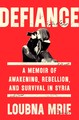
When you purchase a book via a link on this page, we may earn a commission. We appreciate your support for The Atlantic.